14 Results for "

Ricinus communis L.

" in MedChemExpress (MCE) Product Catalog:
Products (14)

14 Results for "Ricinus communis L." in MCE Product Catalog:

Art. -Nr.: HY-NP079
Synonyms: RCA I
Ricinus Communis Agglutinin I (RCA I) is a plant lectin that can be used as a probe to specifically bind biomolecules (such as polysaccharides, peptides, etc.).Ricinus Communis Agglutinin I (RCA I) is a biological material or organic compound that can be used in life science research .
Art. -Nr.: HY-NP0186
Synonyms: RCA I (Biotinylated)
Ricinus Communis Agglutinin I (Biotinylated) (RCA I (Biotinylated)) is a lectin and histochemical stain that binds to glycosylated residues of laminin A, B, and M chains. Ricinus Communis Agglutinin I (Biotinylated) acts as a sensitive probe for the localization of laminin heavy chains, and can also be used to purify laminin from skeletal muscle via lectin affinity chromatography. Ricinus Communis Agglutinin I (Biotinylated) is applicable to studies of intracerebrally transplanted tumors .
Art. -Nr.: HY-NP0141
Synonyms: RCA I (Fluorescein)
Ricinus Communis Agglutinin I (RCA I) Fluorescein is a plant lectin that can be used as a probe to specifically bind biomolecules (such as polysaccharides, peptides, etc.).Ricinus Communis Agglutinin I (RCA I) Fluorescein is a biological material or organic compound that can be used in life science research .
Art. -Nr.: HY-NP0157
Synonyms: RCA I (Rhodamine)
Ricinus Communis Agglutinin I (RCA I) Rhodamine is a plant lectin that can be used as a probe to specifically bind biomolecules (such as polysaccharides, peptides, etc.).Ricinus Communis Agglutinin I (RCA I) Rhodamine is a biological material or organic compound that can be used in life science research .
Art. -Nr.: HY-157328
CAS. Nr.: 1415888-05-9
Target:  

Others

Forschungsgebiete:  

Cancer

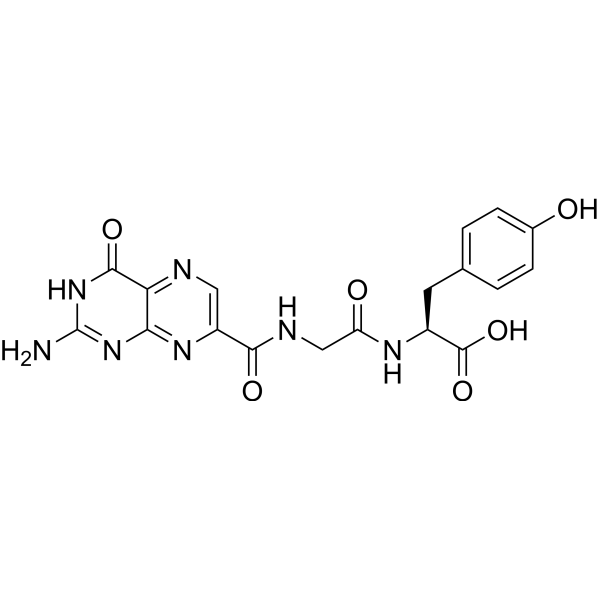
7PCGY is an ricin toxin A chain (RTA) inhibitor with an IC50 value of 6?μM. 7PCGY can be used for the research of cell death .
Art. -Nr.: HY-N3142
CAS. Nr.: 865887-46-3
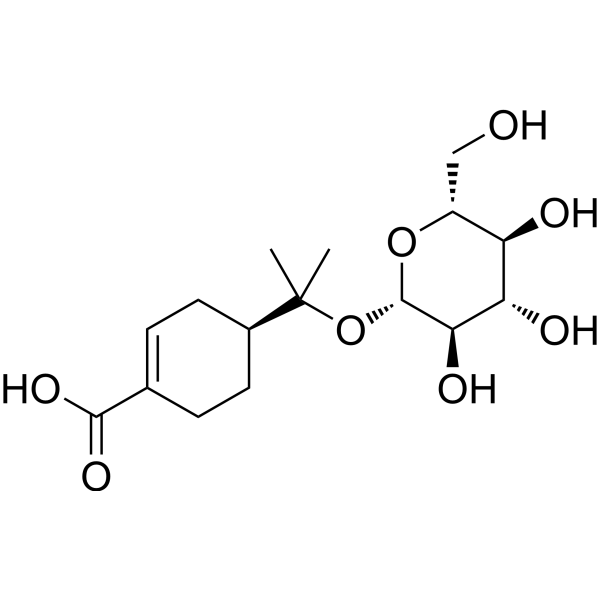
Oleuropeic acid 8-O-glucoside is a terpenic compound, that can be isolated from twigs with leaves of Juniperus communis var. depressa. Oleuropeic acid 8-O-glucoside shows antibacterial activity against three strains of Helicobacter pylori (NCTC11637, NCTC11916, and OCO1), with MIC of 100 μg/mL all .
Art. -Nr.: HY-N3667
CAS. Nr.: 36545-53-6
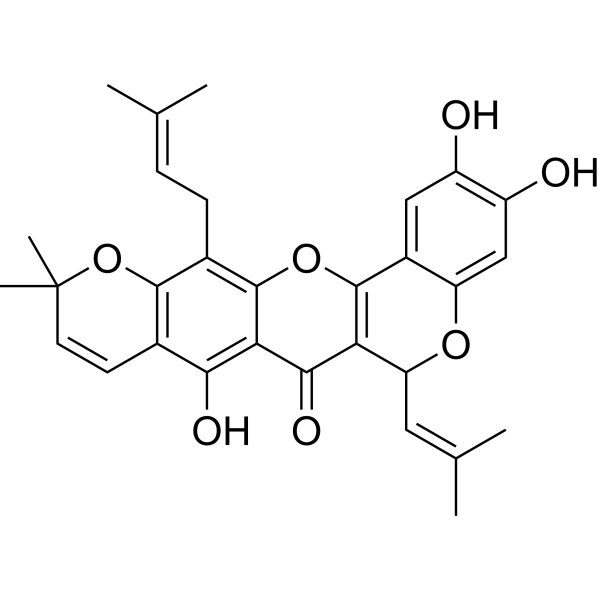
Cycloheterophyllin is a flavonoid, that can be isolated from Artocarpus communis and A. heterophyllus. Cycloheterophyllin shows antiinflammatory activity .
Art. -Nr.: HY-N12713
CAS. Nr.: 20486-38-8
Flavoyadorinin A is a type of flavonoid compound, and can be found in the Leaves of Viscum album Linnaeus var. coloratum Ohwi Epiphyting to Pyrus communis Linnaeus .
Art. -Nr.: HY-N17351
CAS. Nr.: 13186-20-4
3,6-Di-O-galloyl-D-glucopyranoside is a hydrolyzable tannin compound with astringent activity, found in the leaves of Myrtus communis .
Art. -Nr.: HY-N18096
CAS. Nr.: 675881-22-8
Junipercomnoside A is a neolignan glycoside that can be isolated from the aerial parts of Juniperus communis var. depressa .
Art. -Nr.: HY-N17766
CAS. Nr.: 107882-48-4
Methoxylatifolone is a phenylpropanoid compound that can be isolated from the roots of Ferula communis .
Art. -Nr.: HY-W106720
CAS. Nr.: 33189-72-9
Target:  

Insecticide

Forschungsgebiete:  

Infection

(E)-11-Tetradecenyl acetate is a monounsaturated 14-carbon acetate insecticide and a component of the sex pheromone of the currant shoot borer. (E)-11-Tetradecenyl acetate triggers strong antennal responses in males and is used in combination with (Z)-11-tetradecenyl acetate to produce an attracting effect. (E)-11-Tetradecenyl acetate has important application value in the sustainable control of pests, and can be used to monitor population dynamics and implement mating disruption. (E)-11-Tetradecenyl acetate is highly species-specific, triggering only extremely weak responses and showing no attracting activity towards Melanotus communis beetles. (E)-11-Tetradecenyl acetate can be used in studies related to the currant shoot borer and targeted pest control .
Art. -Nr.: HY-N16694
CAS. Nr.: 34539-84-9
6,7-Dehydroferruginol is a diterpenoid compound that can be isolated from the dichloromethane extract of Juniperus communis wood. At a concentration of 100 μg/mL, 6,7-Dehydroferruginol showed no inhibitory activity against 12(S)-LOX and did not inhibit the production of 12(S)-HETE .
Art. -Nr.: HY-L223
853 compounds

Antitussive and antiasthmatic method is a type of treatment strategy in traditional Chinese medicine, mainly used to alleviate symptoms such as coughing and asthma. These symptoms may be caused by various factors, such as: Bronchial asthma, chronic obstructive pulmonary disease, asthmatic bronchitis, cough-induced asthma, and others. Based on existing research in traditional Chinese medicine, many types of Chinese medicinal herbs showed antitussive and antiasthmatic effects. For example: Ardisiae Japonicae Herba, Ginkgo Semen, Amygdalus Communis Vas, Farfarae Flos, Viticis Cannabifoliae Fructus, Eriobotryae Folium etc. Therefore, the active ingredients derived from these traditional Chinese medicine have high medicinal value and have the potential to be developed into drugs for related diseases.

MCE can provide 853 active ingredients that can be obtained from traditional Chinese medicine with antitussive and antiasthmatic functions, which can be applied to drug development and research on disease mechanisms.

  • 1

